
Here is how to estimate construction costs without missing anything. Break the job into phases, list every line item with a quantity, price each one from real quotes, add allowances and contingency, and only then add your markup. Do it one line at a time and the total can be trusted.
What you'll learn
- How to break a job into phases and line items so nothing is left out
- Where the price on each line should come from
- How to add allowances, contingency and markup to reach a contract price
In this lesson
- How to Estimate Construction Costs Line by Line
- Step 1: Read the Plans and the Scope of Work
- Step 2: Break the Job Into Phases
- Step 3: List Every Line Item With a Quantity
- Step 4: Mark Each Line as Labor, Materials or Subcontractor
- Step 5: Price Each Line From a Real Source
- Step 6: Add Allowances and Contingency
- Step 7: Add Overhead and Markup Last
- Lines Builders Often Forget
- Check the Estimate Before You Send It
- Common Mistakes
How to Estimate Construction Costs Line by Line
An estimate is a list of everything the job will cost, with a price on each line. Most estimates that lose money did not have a bad price on a big line. They left a line out, or priced several things as one lump sum that nobody checked.
Doing it one line at a time forces you to think about every part of the job. It also gives you something to compare against later. If you want to see what happens after the estimate, read our lesson on how to build a job budget from your estimate.
Step 1: Read the Plans and the Scope of Work
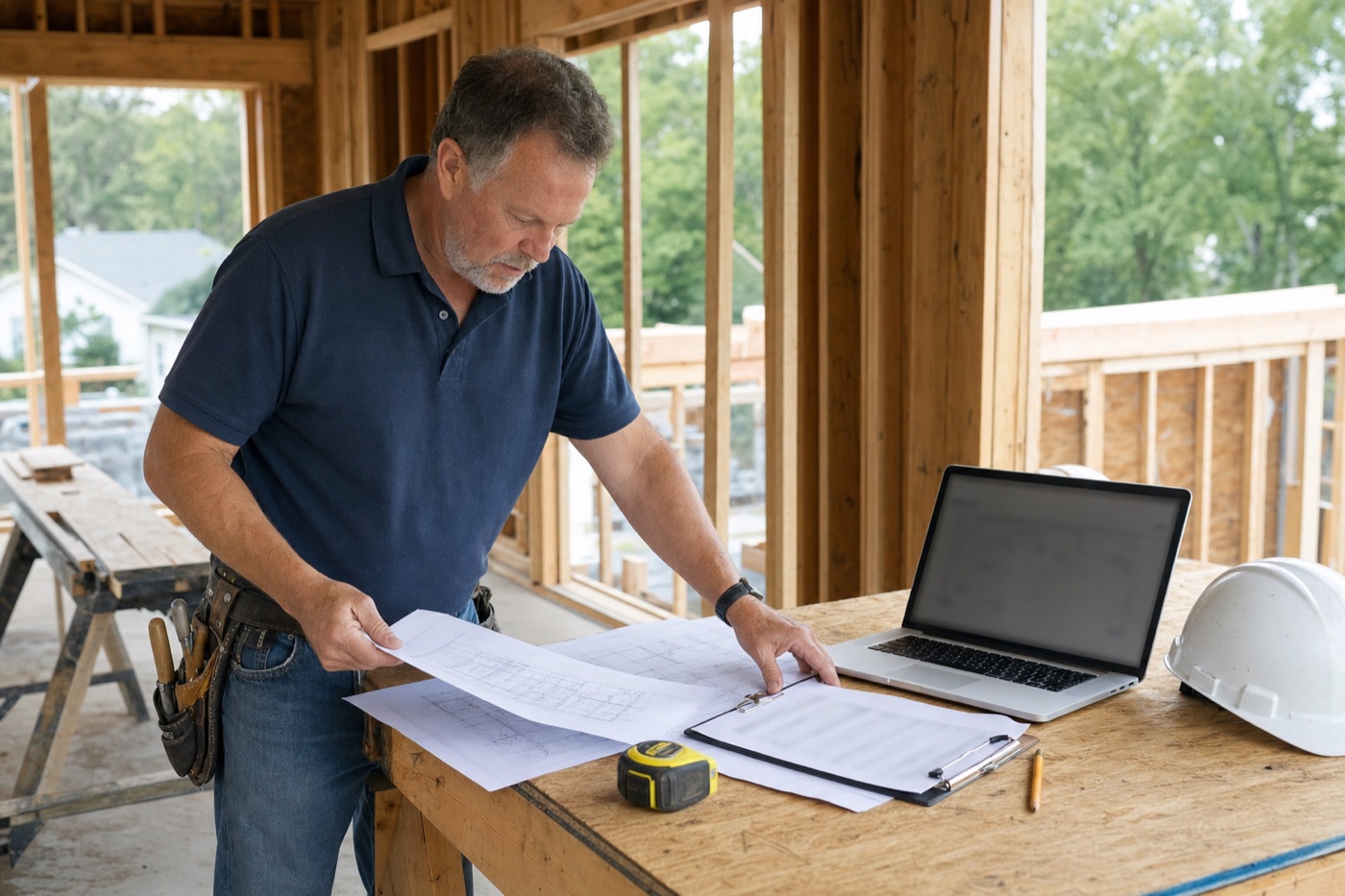
The first part of knowing how to estimate construction costs is reading what you are pricing. Go through the plans, the specs and the scope of work from start to finish. Note what is included, what is not and what is still undecided.
Write your questions down as you read. A missing dimension or a vague note on the plans is much cheaper to ask about now than to pay for later.
Step 2: Break the Job Into Phases
Split the job into phases in the order the work happens. For a bathroom remodel that might be demolition, rough plumbing, rough electrical, drywall, tile, fixtures and paint. For a new home it is a longer list, but the idea is the same.
Phases keep you from forgetting things. It is easy to forget a dumpster or a permit when you are pricing from memory. It is much harder when you are walking through the job in order.
Step 3: List Every Line Item With a Quantity
Inside each phase, list each piece of work as its own line with a quantity and a unit: 120 square feet of tile, 40 linear feet of trim, 1 vanity, 16 hours of labor.
Quantities are what make an estimate checkable. "Tile: $4,000" tells you nothing. "120 square feet at a price per square foot" can be checked, changed and compared with the real bill.
Step 4: Mark Each Line as Labor, Materials or Subcontractor
Give every line a cost type. Labor is your own crew. Materials are what you buy. Subcontractor is work you hire out. This is how you will see later where the money went.
It also stops you from mixing things up. A tile line that has labor and materials in one number hides the thing you most want to know, which is whether the labor or the materials ran over.
Step 5: Price Each Line From a Real Source
Now put a price on every line. Good sources are supplier quotes, subcontractor bids and your own cost on similar recent jobs. Write down where each price came from and the date, so you can check it again if the job is delayed.
Be careful with old numbers. Material prices move, and a price from last year can be wrong by the time you buy. When a subcontractor sends a bid, make sure you know exactly what it includes.
Step 6: Add Allowances and Contingency
An allowance is an amount for something the client has not picked yet, like tile or light fixtures. Give each allowance its own line. Our lesson on how to handle allowance overages with clients shows what to do when a choice goes over.
Contingency is money held back for problems nobody can see yet. Put it on its own line too. If you hide it inside other lines, it gets spent without anyone noticing.
Step 7: Add Overhead and Markup Last
Only after every cost line is priced do you add your overhead and profit. Keep the cost total and the price total separate, so you can always see what the job costs you and what the client pays.
Here is an example, with example numbers only, for a small bathroom remodel:
- Demolition labor: $1,200
- Plumbing subcontractor: $3,800
- Electrical subcontractor: $1,600
- Tile materials: $1,500
- Tile labor: $2,400
- Drywall and paint subcontractor: $2,100
- Vanity allowance: $1,200
- Contingency: $1,000
That adds up to $14,800 of cost. At a 20 percent markup, the contract price is $17,760. You can read more about the numbers on our construction estimating template page.
Notice what the example does. The vanity allowance and the contingency each have their own line, and the markup sits outside the cost. If the plumber's bid comes in higher, you can see it on one line and decide what to do, instead of wondering where $14,800 went.
Lines Builders Often Forget
Most missing money hides in the small lines. Check your estimate for these before you send it:
- Permits and inspection fees
- Dumpster, hauling and cleanup
- Delivery and fuel
- Insurance and bonds for the job
- Temporary power, toilets and protection
- Warranty callbacks and punch list time
Check the Estimate Before You Send It
Read the whole estimate once more and ask what is missing. Permits, dumpsters, cleanup, insurance, delivery and a final clean are the usual forgotten lines. Then check that the scope of work and the estimate match, line for line.
If you want a wider view on tracking costs once the job starts, read our guide on how to track job costs. The National Association of Home Builders also lists education for builders if you want to go deeper on estimating.
Common Mistakes
The biggest mistake is pricing from the total down, picking a number and then filling in lines to match it. Always go the other way: price every line, then add them up.
The second is mixing cost and price, so your markup hides inside the lines. The third is skipping the check at the end. Ten minutes reading the estimate for what is missing can save you a month of profit.
Now you know how to estimate construction costs: build it line by line, source every price and keep cost and price apart, and your estimate becomes something you can trust.
Checklist
- Read the plans and the scope of work before you price anything
- Split the job into phases in the order the work happens
- List every line item with a quantity and a unit
- Mark each line as labor, materials or subcontractor
- Price each line from a real quote or your own recent costs, and write down where it came from
- Put allowances and contingency on their own lines
- Add your overhead and markup last, so cost and price stay separate
- Read the estimate once more and ask what is missing before you send it
Try It in Smart Builder 360
Smart Builder 360's Project Estimator is built the same way as this lesson. It organizes cost categories and line items, with cost type, quantity and unit cost on each line, then works out estimated cost, margin, contract price and projected profit. Start a free 30-day trial, no credit card, and build your next estimate in it.
Start free trialFrequently Asked Questions
How do you estimate construction costs for a small job?
List every piece of work, put a quantity on each, and price each line from a real quote or your own recent costs. Add allowances for things the client has not picked, add a contingency for surprises, then add your overhead and profit. Small jobs follow the same steps as big ones, with fewer lines.
What should a construction estimate include?
It should include every phase of the work, the labor, materials and subcontractors on each line, allowances, a contingency, and your overhead and profit. It should also say what is not included. Leaving something out is the most common way an estimate loses money.
How do I price each line of an estimate?
Use real numbers. That means supplier quotes, subcontractor bids and your own cost from similar recent jobs. Write down where each price came from and the date. A price you cannot trace is a guess, and guesses on big lines hurt the most.
What is the difference between markup and profit?
Markup is the percentage you add on top of your cost. Profit is what is left after all your costs, including overhead, are paid. A 20 percent markup does not mean you keep 20 percent of the price, so work out your overhead before you pick a markup. These numbers are an example only.
How much contingency should I add to an estimate?
There is no single right number. It depends on how complete the plans are, how old the building is and how much is still unknown. Put it on its own line, so you can see how much of it you have used as the job goes on.
Should I use a template or software for estimating?
Either can work if it keeps cost and price apart and makes you list every line. A construction estimating template is a good start. Software helps when you want the estimate to carry through to the budget and track actual cost.